
|

|

|

|

|

|
BIGNONIACEAE - - Bignonia Family
|
|
|
|
|
|
|
|
|
Bottomland forests, swamp forests, fencerows, old fields, forests, thickets, disturbed areas. In the pre-Columbian landscape this plant was primarily limited to swamps and bottomlands; it has done well as a weedy colonizer of abandoned farmland, fencerows, and thickets (where particularly conspicuous on fenceposts and old tobacco barns). In swamps of the Coastal Plain it is a common liana, often with its foliage in the canopy 30-40 m above the ground, and with stems to 15 cm in diameter. Even when the foliage cannot be seen, Campsis is immediately recognizable by its shreddy tannish bark (unlike any of our other high-climbing vines).
Habitat information from:
Weakley, Alan S., Flora of the Southern and Mid-Atlantic States, Working Draft of 21 May 2015.
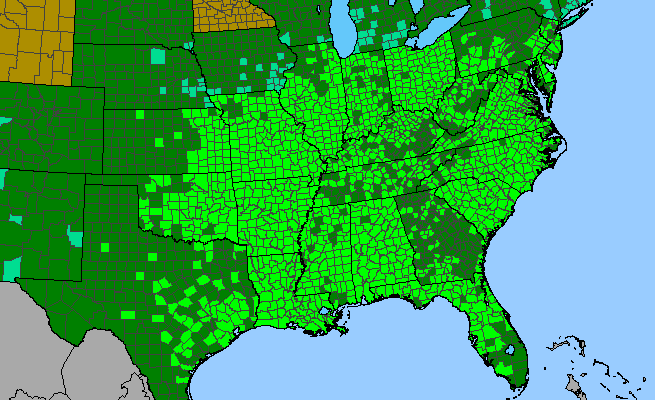
Kartesz, J.T., The Biota of North America Program (BONAP). 2015. North American Plant Atlas. (http://bonap.net/napa). Chapel Hill, N.C. [maps generated from Kartesz, J.T. 2015. Floristic Synthesis of North America, Version 1.0. Biota of North America Program (BONAP). (in press)].
Guide to the Wildflowers, Trees and Shrubs of North Georgia and Adjacent States
Web Page by Richard Ware
send Richard an E-mail